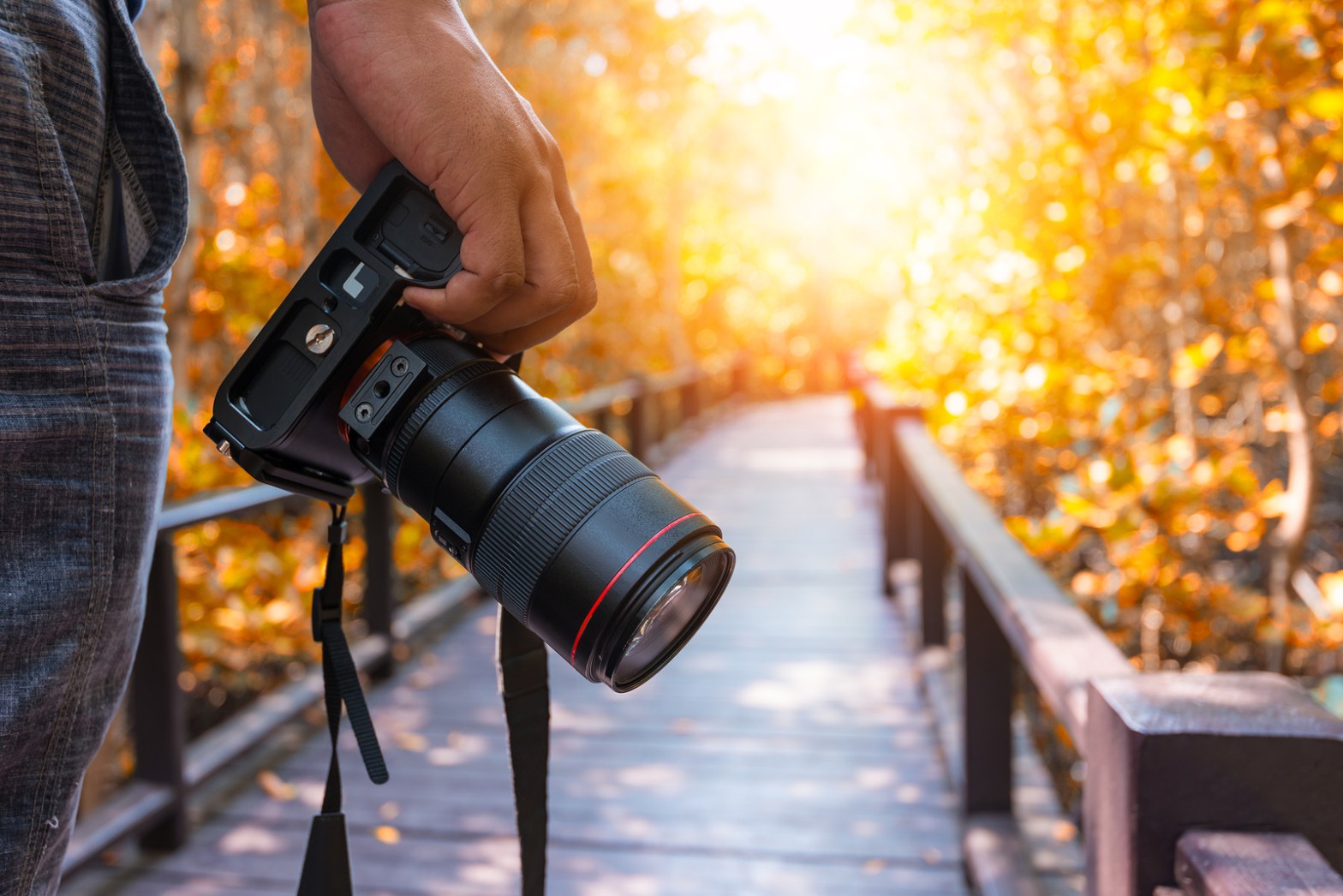
1. Use your camera’s Aperture Priority and Shutter Priority mode
If Guide mode seems daunting for you now, your camera may ease you gently with Aperture Priority mode along with Shutter Priority style , also called the semi-manual or even semi-auto manners (Notice: Some experts prefer to take largely at Aperture Priority mode, but some favor Manual style ). Aperture is the size of this opening at the lens whenever you’re shooting a photo, also determines the total amount of light allowed into the camera.
Shutter speed is the period of time which the camera of the camera stays open once you’re shooting a photograph, enabling light to reach on your camera’s detector (it is also called exposure period ).
Aperture Priority style is really a favorite of mine. I love taking photos at which the topic or part of this topic is in focus while the background remains dreamy and fuzzy. I do so appearance by placing my aperture into a massive dimensions (suggested by a reduce f-number). If you place your aperture to a bigger size (signaled by a larger f- number) you can realize what is called deep DOF, in which both foreground and background are both sharp, clear and accountable.
Folks generally utilize Shutter Priority mode whenever they would like to catch movement in a given way. They use a quick shutter speed to”suspend” a fast-moving thing punctually. A slower shutter speed might demonstrate the movement progression, producing a fuzzy image of this topic.
2. Purchase an excellent tripod.
I’ve discovered I have an increased capacity to maintain quite still when shooting slower shutter speeds:-RRB-, however I do understand my limits. That is when it is time to get a tripod that is nimble. They’re extremely useful for night extended exposures, photographing woods, also for special effects such as this. I utilize my own DSLR’s built-in timer in combination with the tripod (therefore that I do not shake the camera by simply pushing the button ). Occasionally my remote shutter release cable will not come in useful, for all those photos I want to catch in the present time.
3. Get acquainted with your camera’s autofocus capacities (AF style ).
When you look through your camera lens you will observe a range of attention points. The middle focus point (that can be the most sensitive stage ) must be pointed directly at your own subject. If your topic is far off centre, you are going to find a better shot should you pick an off-center focal point which pops with your own subject. When employing a wide aperture feeling such as f/2.8, don’t use the lock focus/recompose procedure, as your topic might become blurred. Rather, select a focal stage closest to your topic to guarantee clarity.
My Canon has Just One Shot style and Al Servo mode (constant ), in addition to Al Focus style that is like A Single Shot mode using an automated sensor which enables it to enter Al Servo mode when it detects motion. Greek? Allow me to make it simple for you. Whenever you’re shooting a still topic employ One particular mode. In case you’ve got a moving topic which you would like to catch in attention, place your camera to the Constant focus manner (that can be Al Servo in my Canon), so it always focuses on your moving topic.
4. ISO stone!
I put my camera into a very low ISO rate for bright light conditions along with a higher ISO rate for low cost scenarios.
ISO 200-400 functions for muddy outside daylight, outside color, or inside where the spectacle is well-lit.
ISO 800 may at times be utilized in low light outside or indoors with no flash. Head the shutter rate — when it becomes too slow it is possible to increase ISO to produce it quicker, use a tripod to adapt the camera speed, or utilize flash. To refrain from graininess in such low-light scenarios, place the ISO mount and low your DSLR onto a tripod to have a very clear shot. Or, you may always use a high ISO (to raise shutter speed enough to get a handheld shooter ) and take pleasure in the imaginative grain!
5. The Metering Modes
Your camera features an integrated attribute that automatically controls vulnerability, but occasionally there are situations in which you want more control over the vulnerability — for example, if you’re shooting at the glowing light of your camera darkens the general photograph, leaving your topic matter underexposed. In situations such as these it is the right time to pay a visit to your camera Metering styles and choose one to allow you to control vulnerability (also I’d love to add that this is far simpler than you might believe ). DSLRs are put to Evaluative Metering mode , and that does a nice job the majority of the time. Things to do if it does not? Here’s a small situation to help me clarify… it is day — rich, gold light — the ideal background for a portrait session with my own daughter. At Evaluative Metering mode, the camera also assesses the general vulnerability of the photograph, taking into consideration that the backlight. To guarantee correct vulnerability of my topic, I just pick the Partial Metering style or Spot Metering style — those manners will soften the field regardless of the backlight (Spot Metering style provides a little more hands than Partial Metering mode). Center-Weighted Average Metering style is a combo of Evaluative and Partial/Spot Metering manners and is likely least employed out of all of the modes. It assesses the whole scene, however, gives priority to the centre section of the framework (so that your topic always must be in the middle of the framework when using this style ).
6. Exposure Compensation
Think about your camera for a robot. It will get the work done with artificial intelligence, producing gratifying and successful results the majority of the moment. However, there are occasions when you, the individual being photographer, will have to reevaluate the system to attain the ideal exposure to your picture, particularly in cases where there are mostly white tones on your landscape, or even largely black tones. By way of instance, snowscapes are obviously bright to the eye, particularly in sunlight. If left up into the camera , the system will automatically darken the spectacle since it’s programmed to average out the tones to 18% grey whenever it requires a photograph. You may easily fix this type of improper exposure simply by visiting the”+/ / – sliding scale” attribute (found on many digital cameras) and increasing or diminishing exposure so (in this instance of this snowscape scene, so you may improve it). For scenes with dark tones, then the camera may average them out to 18% grey also, so reduce exposure compensation to attain authentic black tones. Whether you are decreasing or increasing vulnerability, moving you to two full stops is suggested. I particularly love to play it through late day/early day photoshoots who have rich, gold backlighting — I boost it to brighten theme faces (an alternate with the Spot Metering style cited in #5).
7. Utilize White Balance settings to attain more natural-looking pictures.
Different light sources produce a number of colour casts in our photographs, maybe not all of that seem really natural. DSLR cameras possess white balance settings to pick from to help counteract those issues. Perhaps you will discover some intriguing outcomes.
8. Use photo-editing apps like Photoshop to find the most out of your photos and add exceptional effects.
I love to’take out of the intestine,’ Gently ripping away, not giving careful consideration to camera configurations, but I’m forcing myself to take either Aperture Priority mode or complete Manual today. My photographs will be the better for this, since I have much more control. I really do use Photoshop for creating alterations and corrections at the post-processing point, in addition to for incorporating specific effects (Adobe presents free of charge 30-day trials of the apps ). I like educating others Photoshop abilities within my VisualPoetry online workshop show.
9. Fill up the memory card.
This suggestion goes together along with my’shoot in the gut’ mindset. Take lots and a lot of images, and you’ll make certain to catch something quite special and distinctive. If you merely choose to maintain a few of those photographs in your own card, then you’ve been successful!
10. Change up the point of view of your own photos.
Consider thickness and spatial connections between objects from your photographs. A few of the most fascinating shots may come in veering away from your typical photography customs.
https://clickphoto.photo.blog/2019/12/21/how-to-click-best-photos-in-smartphone/
 Click Photo